
Masters 2026 Scorecard: Printable Augusta National Hole by Hole PDF
The Masters 2026 scorecard is your complete guide to Augusta National Golf Club hole by hole. This page covers every hole at Augusta National with its official name, par and yardage for the 90th Masters Tournament played April 9 to 12, 2026. Print it out, track each round and follow the action from home.
Augusta National plays to par 72 across 7,565 yards from the championship tees. The front nine and back nine are both par 36. One unique fact about this course: every yardage ends in a zero or five. Co-founder Clifford Roberts set this tradition in the 1930s to keep things simple and consistent.
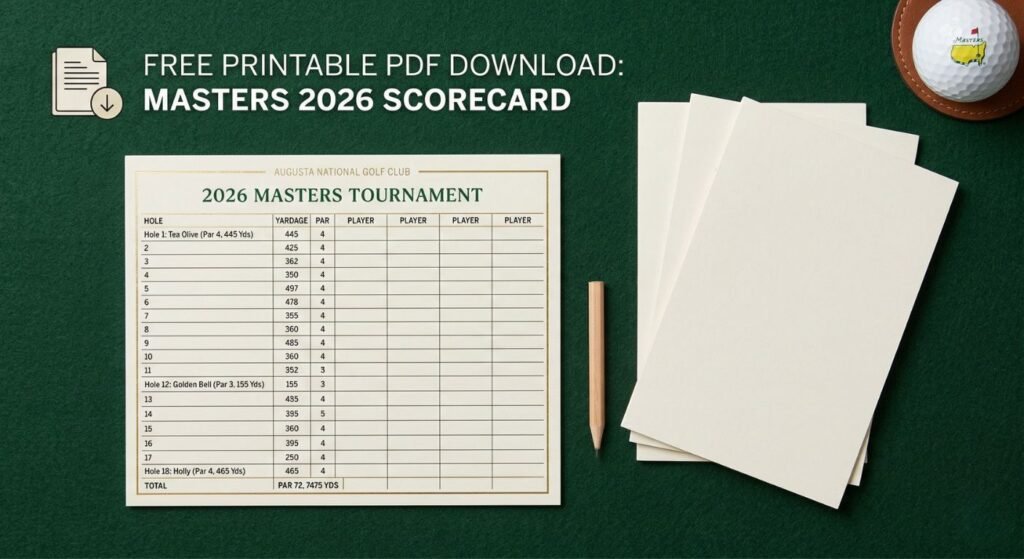
Masters 2026 Scorecard — Augusta National Golf Club
All yardages below are from the championship tees used during the Masters Tournament.
| Hole | Name | Par | Yards |
|---|---|---|---|
| 1 | Tea Olive | 4 | 445 |
| 2 | Pink Dogwood | 5 | 585 |
| 3 | Flowering Peach | 4 | 350 |
| 4 | Flowering Crab Apple | 3 | 240 |
| 5 | Magnolia | 4 | 495 |
| 6 | Juniper | 3 | 180 |
| 7 | Pampas | 4 | 450 |
| 8 | Yellow Jasmine | 5 | 570 |
| 9 | Carolina Cherry | 4 | 460 |
| OUT | Front 9 | 36 | 3,765 |
| 10 | Camellia | 4 | 495 |
| 11 | White Dogwood | 4 | 520 |
| 12 | Golden Bell | 3 | 155 |
| 13 | Azalea | 5 | 545 |
| 14 | Chinese Fir | 4 | 440 |
| 15 | Firethorn | 5 | 550 |
| 16 | Redbud | 3 | 170 |
| 17 | Nandina | 4 | 450 |
| 18 | Holly | 4 | 465 |
| IN | Back 9 | 36 | 3,800 |
| TOTAL | 72 | 7,565 |
2026 course note: Hole 17 (Nandina) is the only hole changed for 2026. The front of the tee was reduced by 12 yards and the tee plate relocated which increased the official playing yardage by 10 yards to 450. Hole 13 (Azalea) stays at 545 yards after the tee was moved back 35 yards in 2023.
Download Free Masters 2026 Scorecard PDF
Get the full Augusta National scorecard in a clean print-ready PDF. It has all 18 holes with names, pars, yardages and four blank score columns for every round. Free to download. No signup needed.
Works on phone, tablet and desktop. Print on standard A4 or Letter paper.
Also Check: Masters 2026 TV Schedule | How to Watch Masters 2026 Online
Augusta National Hole by Hole Breakdown
Every hole at Augusta National has its own name, story and challenge. Here is a quick breakdown of all 18 holes so you know exactly what players face during the tournament.
Front Nine
Hole 1: Tea Olive (Par 4, 445 yards)
The opening hole is a slight dogleg right that plays uphill. A deep bunker sits 317 yards from the tee. The green falls off sharply at the back and right. A solid par here builds a good foundation for the round.
Hole 2: Pink Dogwood (Par 5, 585 yards)
This is the longest hole on the course at 585 yards. The dogleg left can be reached in two shots with a well-placed drive. Deep bunkers guard the front of the green. In 2025 it played as the easiest hole on the course with a scoring average of 4.615. Good players target birdie here early in the round.
Hole 3: Flowering Peach (Par 4, 350 yards)
At 350 yards this is the shortest par 4 on the course. Big hitters can drive it near the green but four fairway bunkers catch anyone who goes left. The green slopes sharply right to left. Precision off the tee is more important than distance here.
Hole 4: Flowering Crab Apple (Par 3, 240 yards)
A long demanding par 3 that needs a long iron or fairway metal from most players. A deep bunker guards the right side of the green with another bunker to the left. Wind at Augusta makes club selection tricky on this hole. It is one of the toughest par 3s in major championship golf.
Hole 5: Magnolia (Par 4, 495 yards)
The longest par 4 on the course. The tee moved back 40 yards in 2019 which made the fairway bunkers require a 313-yard carry to clear. The uphill dogleg left punishes loose drives. In 2025 this was the hardest hole on the course with a scoring average of 4.324.
Hole 6: Juniper (Par 3, 180 yards)
The tee sits well above the three-tier green below. The slope from front to back makes the pin position very important. Players who miss the right tier face a tough two-putt. Getting the distance right is everything on this hole.
Hole 7: Pampas (Par 4, 450 yards)
A narrow chute of Georgia pines lines both sides of the fairway. Players aim left-center off the tee to find a flat lie. The green has five bunkers around it which is more than any other hole at Augusta National. This hole demands accuracy from tee to green.
Hole 8: Yellow Jasmine (Par 5, 570 yards)
An uphill par 5 with a fairway bunker on the right side. There are no bunkers around the green itself but severe mounding catches anything offline. Players who find the fairway have a real birdie chance here.
Hole 9: Carolina Cherry (Par 4, 460 yards)
The front nine finishes on a hole famous for its back-to-front sloping green. A drive down the right side removes the two left-side bunkers from play. Getting the ball below the hole is key to any birdie chance.
Amen Corner — Holes 11, 12 and 13
Amen Corner is the most famous three-hole stretch in golf. It runs from Hole 11 through Hole 13 on the back nine. More Masters titles have been won and lost here than anywhere else on the course.
Hole 10: Camellia (Par 4, 495 yards)
The back nine starts with a dramatic downhill dogleg left. The tee shot plunges down a steep slope and players can pick up extra distance from the roll. The green slopes from back right to front left. This is statistically the second hardest hole in Masters history and a tough start to the back nine.
Hole 11: White Dogwood (Par 4, 520 yards)
This is where Amen Corner begins. A straight powerful tee shot down the right side is essential. A pond guards the left of the green and a bunker sits right-center. Statistically this is the hardest hole in Masters history with a scoring average of 0.304 over par across all editions. Larry Mize made one of the most dramatic chip-ins in golf history here during the 1987 playoff.
Hole 12: Golden Bell (Par 3, 155 yards)
The shortest hole at Augusta National at 155 yards. Swirling winds above the pines make club selection almost impossible to judge. Rae’s Creek runs in front of the shallow green. One bunker sits up front and two more sit behind. Jordan Spieth made a quadruple-bogey 7 here in 2016 and lost a five-shot lead in an instant.
Hole 13: Azalea (Par 5, 545 yards)
The tee moved back 35 yards in 2023 which made this dogleg left much harder to reach in two. A tributary of Rae’s Creek runs across the front of the green. Players who hit a big drive can still attack the green with a mid-iron. Four bunkers sit behind the putting surface. About 1,600 azaleas line the hole from tee to green.
Back Nine Finish
Hole 14: Chinese Fir (Par 4, 440 yards)
This is the only hole at Augusta National with zero bunkers. The green makes up for it with some of the most severe contours on the course. The terraced surface drops sharply from left to right. A well-struck approach shot can still leave a very tricky putt.
Hole 15: Firethorn (Par 5, 550 yards)
The biggest risk-reward hole on the course. A solid drive sets up the decision: go for the green in two over the pond or lay up short. Gene Sarazen made the most famous shot in golf history here in 1935 with a 4-wood double eagle. This is historically one of the easiest holes on the course and a prime birdie chance late in the round.
Hole 16: Redbud (Par 3, 170 yards)
The entire tee shot carries over water to the green. The putting surface slopes hard from right to left. Three bunkers protect the green. Sunday pin locations on the lower shelf create incredible drama in the final round. Tiger Woods made one of the most iconic chip shots in Masters history here in 2005.
Hole 17: Nandina (Par 4, 450 yards)
The only hole changed for 2026 with 10 extra yards added to reach 450 total. A narrow tree-lined fairway demands a precise tee shot. Two bunkers protect the three-tiered green. In 2025 this hole ranked as the ninth hardest on the course with a scoring average of 4.16.
Hole 18: Holly (Par 4, 465 yards)
The closing hole is an uphill dogleg right with trees protecting the right side off the tee. A drive up the left center of the fairway opens up the best angle into the two-tier green. Many Green Jackets have been decided right here on the 18th at Augusta National.
Augusta National Golf Club — 2026 Course Facts
| Detail | Info |
|---|---|
| Course | Augusta National Golf Club |
| Location | Augusta, Georgia, USA |
| Par | 72 |
| Total Yardage | 7,565 yards |
| Front Nine | Par 36 / 3,765 yards |
| Back Nine | Par 36 / 3,800 yards |
| Longest Hole | Hole 2: Pink Dogwood (585 yards) |
| Shortest Hole | Hole 12: Golden Bell (155 yards) |
| Hardest Hole (all-time) | Hole 11: White Dogwood (0.304 over par) |
| Hardest Hole (2025) | Hole 5: Magnolia (avg 4.324) |
| Easiest Hole (2025) | Hole 2: Pink Dogwood (avg 4.615) |
| Tournament Dates | April 9–12, 2026 |
| Edition | 90th Masters Tournament |
| Defending Champion | Rory McIlroy |
| Course Record | 63: Nick Price (1986) and Greg Norman (1996) |
| 2026 Change | Hole 17 (Nandina) lengthened to 450 yards |
How to Use This Masters Scorecard
Tracking scores while watching on TV
Write each player’s score per hole as you watch the broadcast. Use the Par column as your guide. A score below par on a hole is good. A score above par means the player struggled on that hole.
Running an office pool
Print one scorecard for each person in the group. Everyone picks their top players before the tournament starts. Track each player’s running total after every round. The person with the lowest combined total at the end wins.
Following the leaderboard
The Masters leaderboard shows scores as a number relative to par. A player at -8 is eight strokes under par for the tournament. Use this scorecard to see which holes helped or hurt their score on any given day.
Masters Scoring Terms Every Fan Should Know
| Term | Meaning |
|---|---|
| Albatross | 3 under par on one hole |
| Eagle | 2 under par on one hole |
| Birdie | 1 under par on one hole |
| Par | Expected score for the hole |
| Bogey | 1 over par on one hole |
| Double Bogey | 2 over par on one hole |
| Triple Bogey | 3 over par on one hole |
| The Cut | Top 50 and ties after Round 2 advance to the weekend |
| Under Par | Total score below the expected score |
| Over Par | Total score above the expected score |
Masters Scorecard FAQs
What is par at Augusta National in 2026?
Par 72. The front nine is par 36 and the back nine is par 36.
How long is Augusta National in 2026?
7,565 yards from the championship tees. This is the official Masters Tournament yardage.
What hole changed at Augusta National for 2026?
Hole 17, Nandina, is the only hole changed for 2026. The front of the tee was reduced by 12 yards with the tee plate relocated, increasing the official playing yardage by 10 yards to 450 yards.
What is Amen Corner at the Masters?
Amen Corner covers Holes 11, 12, and 13 on the back nine. It is the most famous stretch in golf and has decided more Masters outcomes than any other part of Augusta National.
What is the hardest hole at Augusta National?
Hole 11, White Dogwood, is statistically the hardest hole in Masters history, playing an average of 0.304 over par across all editions of the tournament. In 2025 specifically, Hole 5 Magnolia played as the hardest with a scoring average of 4.324.
What is the easiest hole at Augusta National?
Hole 15, Firethorn, is historically one of the easiest holes on the course. In 2025 Hole 2, Pink Dogwood, played as the easiest with a scoring average of 4.615.
What is the course record at Augusta National?
63, set by Nick Price in 1986 and matched by Greg Norman in 1996.
Why do all Augusta National yardages end in zero or five?
Co-founder Clifford Roberts started this tradition in the early 1930s. Since pin positions change daily, Roberts preferred rounding yardages to the nearest five for simplicity and order.
What is the longest hole at Augusta National?
Hole 2, Pink Dogwood, at 585 yards. It is a par 5 and the longest hole on the course.
What is the shortest hole at Augusta National?
Hole 12, Golden Bell, at 155 yards. It is the most feared par 3 in golf.
The Masters 2026 scorecard on this page covers all 18 holes at Augusta National with official pars, yardages and hole names. Download the free printable PDF before April 9 and keep it close during tournament week. It makes every round more enjoyable when you know exactly what each hole asks from the best players in the world.